 VisualNeuroscience.AI
Hallucinations
perceptions in the absence of a stimulus · Boksa 2009Boksa P. On the neurobiology of hallucinations. Journal of Psychiatry & Neuroscience 2009;34(4):260–262. PMID 19568476
MNI152 template · AAL-116 parcellation
The model, as a circuit
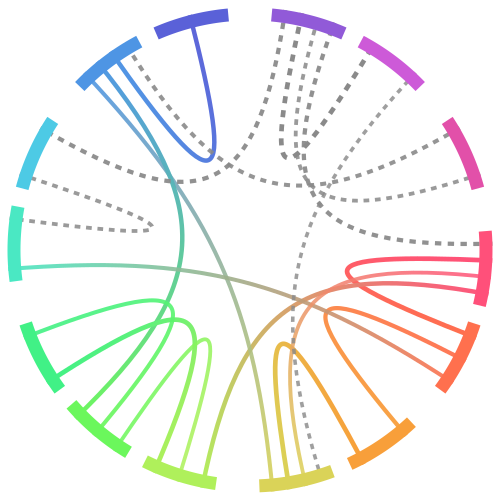
Allen's model is a claim about signal flow. Hearing is not what breaks — someone who hallucinates hears the world exactly as anyone else does. What breaks is the handling of the brain's own inner speech: the control regions normally send a copy of the command with it, marking it as self-generated, and when that copy fails to arrive the same inner speech is heard as a voice from somewhere else.
Hearing the world unchanged in both
Sound arrives from the world, is relayed by the thalamus and is worked up through the auditory cortices until it is heard. This pathway is the same either way: hallucination is not a failure of hearing, and someone who hallucinates hears the world as anyone else does.
The brain's own inner speech tagged as one's own
Not only in illness
Boksa opens by unsettling the assumption that hallucinations belong to schizophrenia alone. She adds one crucial caveat: it is unknown at present whether hallucinations are generated by similar mechanisms in patients and in healthy people.
of people with schizophrenia experience hallucinations, auditory being the most common.
of children and adolescents report hallucinations, across six community surveys in various countries.
of bereaved spouses report hallucinations of the deceased.
halves of a ping pong ball over the eyes, plus a waterfall recording, can induce vivid dreamlike imagery in some healthy people.
What the imaging found
Allen and colleagues reviewed structural, functional and connectivity studies of the hallucinating brain. Boksa's summary of their findings, and of the model they propose.
| Method | Finding |
|---|---|
| Structural | The most consistent result is reduced grey matter volume in the superior temporal gyrus, including primary auditory cortex. One fairly large study also found volume reduction in the DLPFC, suggesting faulty frontotemporal interactions may underlie the sense that hallucinations are involuntary. |
| Functional | Studies of actively hallucinating participants generally report increased activity in language areas and primary auditory cortex, strongly implicating superior and middle temporal gyri — though other nonsensory cortical and subcortical areas have been implicated too. |
| Connectivity | Diffusion tensor and functional imaging concur in showing altered connectivity among temporal, prefrontal and anterior cingulate regions. |
| Allen's model | Overactivity in primary and/or secondary auditory cortices, altered connectivity with inferior frontal language areas, and weakened control by anterior cingulate, prefrontal, premotor and cerebellar cortices. |
| Lesions | In psychologically normal individuals hallucinating after a lesion, the lesion was generally in the sensory pathway of the same modality as the hallucination. |
| Treatment | Slow rTMS over right temporoparietal cortex reduced treatment-resistant auditory hallucinations, mean effect size 0.76. Boksa offers a comparison: clozapine versus typical antipsychotics scored 0.48 on the Brief Psychiatric Rating Scale — though that meta-analysis did not target hallucinations specifically. |
Windows onto the mechanism
Three approaches Boksa reports, each with the reservation she attaches to it.
| Approach | What it showed | Boksa's reservation |
|---|---|---|
| Self-tickling | A self-generated stimulus is attenuated because we anticipate its sensory consequences. Healthy controls found self-tickling less intense than an experimenter's touch; participants with auditory hallucinations or passivity phenomena did not discriminate between the two. | The underlying mechanisms for such misattribution are not yet understood. |
| Hypnosis | The right anterior cingulate activated in hypnotisable people both when hearing real speech and when instructed to hallucinate, but not when imagining speech — suggesting a role in attributing speech to an external source. | Controls should also have activated the ACC on hearing real speech, and did not. Altered ACC activation also appears in non-hallucinatory hypnotic suggestion, so it may reflect suggestibility itself. |
| REM sleep | Hallucinations and delusions are regular features of REM. On waking from REM dreams, women — but not men — showed a deficit in monitoring self-generated versus externally generated stimuli. | Offered as a potential insight rather than an established parallel. |
Where it stops
The editorial's closing argument, which is as much about the limits of the evidence as about the evidence.
In studies with human participants, neural processes can only be shown to correlate with hallucinations, not to definitively cause them. Every finding above is an association.
Animal models, which are normally where causal evidence comes from, do not resolve it. Monkeys and dogs can apparently tell their own vocalisations from another animal's, so one might expect them to misattribute under abnormal conditions — but assessing whether an animal is hallucinating is problematic. Monkeys given drugs known to produce psychosis in humans do show behavioural changes, yet what has been categorised as hallucinatory-like behaviour, such as responding to nonapparent stimuli or staring for extended periods, is too nonspecific for research into mechanism.
Boksa's own conclusion is that although useful insight has been gained, we still have a long way to go to fully understand what causes the voices and visions of schizophrenia.
An educational visualization of Boksa P, “On the neurobiology of hallucinations,” Journal of Psychiatry & Neuroscience 2009;34(4):260–262 — open access at PMC2702442. Regions are drawn on the MNI152 template using the AAL-116 parcellation; each named region is matched to its nearest atlas parcel, and where that match is approximate the panel says so. The editorial concerns auditory hallucinations in schizophrenia almost throughout and does not address serotonergic, glutamatergic or default-mode accounts. It is now well over fifteen years old, and the field has moved. Not a diagnostic tool. About · Privacy & support.